The Other:
Forrest Gump (mentally retarded)
A Beautiful Mind (paranoid schizophrenia)
The Last of Mohicans (native-american)
Avatar (aliens)
Schindler's List (jews)
Uncle Tom's Cabin (african-americans)
We need one for Mexicans and Muslims now.
It was the artists of the period, however, who had the biggest impact on changing the perspective on perspective. Recall that the invention of perspective in art was perhaps the single most important development of the Renaissance. The artists broke with medieval renderings of the world as a great chain of being ascending floating from the depths of earthly existence to the heavenly gates. The use of perspective took the human gaze away from the heavens toward the linear plane of an earthly world populated by subjects and objects. The gaze was no longer meant to conjure up the exultant expectation of ascending to the world above but, rather, an impartial ordering of the objective world below. Francis Bacon’s scientific method and, later on, the rationalism of Enlightenment philosophers flowed inexorably and, in no small part, from the reorientation of time and space rendered by Renaissance artists on their canvases.

Paul Cezanne was the first to break ranks with the long tradition of the single perspective in art. His Still Life with a Basket of Apples, depicts a table from different perspectives. The artist became obsessed with the multiperspective approach to the canvas. He wrote his son in 1906, conveying his sense of excitement:
Here on the edge of the river, the motifs are plentiful the same subject seen from a different angle gives a subject for study of the highest interest and so varied that I think I could be occupied for months without changing my place, simply bending more to the right or left.

Pablo Picasso’s Les Demoiselles d’Avignon introduced the new idea of Cubism in art. In the painting, two figures are shown frontally, “but with noses in sharp profile. The seated figure has her back to the viewer but her head is seen from the front.”

Cubism was a highbrow artistic expression that appealed far more to the avant-garde elites in
The manipulation of temporal and spatial orientation took moviegoers out of their conscious reality of normal temporal and sequential order and into a fantasy world where all sorts of new realities are possible to imagine. It’s no accident that
James Joyce played with time and space and multiple perspectives in his literary works, with similar effect to what Cezanne, Picasso, and the Cubists were able to do on canvas. In Ulysses, Joyce’s protagonist, Bloom, jumps in and out of a dizzying array of places, times, and realities as his mind wanders through the universe over galaxies far away and the tiniest realm of the molecule the course of a very average day in Dublin. With Joyce we are introduced, for the first time, to stream of consciousness, the kind we all experience every waking and sleeping moment, as our own minds wander off into different time dimensions and distant spaces, of which we are not always in control. What Joyce is suggesting is that every individual is experiencing multiple perspectives and realities and occupying different places and times in his own mind throughout the day, just like Bloom. Our minds simply won’t let us settle on a single perspective or, for that matter, allow us to accommodate a seamless objective reality. Edmund Wilson caught the brilliance of Joyce’s accomplishment when he wrote:
Joyce is indeed really the great poet of a new phase of of human consciousness. Like Proust’s or Whitehead’s or Einstein’s world, Joyce’s world is always changing as it is perceived by different observers and by them at different times.
Although like the Romantics Joyce believed that consciousness is an embodied experience, and that the expression of love and compassion is a natural predisposition, his view of human vulnerability amid imperfection differs in an important respect. While Romantics like Whitman celebrate human vulnerability and pay homage to the importance of erotic sexuality as a way of getting in touch with one’s natural vitality, there is a tendency to romanticize human potential by creating an ideal transcendent self that no one can ever hope to live up to.
Joyce’s protagonists remind us far more of ourselves, it’s not that Leopold and Molly aren’t desirous of ascent. But, as Martha Nussbaum reminds us, life keeps interrupting in all of its unanticipated twists and turns. Life is messy, chaotic, and full of banality, some of it rising to comic levels of hysteria rather than cosmic levels of transcendence. We all soldier on—but in the midst of our desire for transcendence, we need to take time out for a stool or relieve our stress with five minutes of masturbation. In the real world, our lives are lived out like the puck of a yo-yo. We’re up--we’re down. We have moments of brilliant insight and moments of stupefying despair.
What Joyce and Nussbaum understand is that the ordinariness of our individual lives--with all of its imperfections and neediness--that we find our common humanity and the emotional wherewithal to empathize with others. By putting too much emphasis on transcendence, the Romantics risked leaving the subtle impression that the imperfections of human beings are intolerable, even disgusting Joyce put it best when he wrote, “Life we must accept as we see it before our eyes, men and women as we meet them in the real world, not as we apprehend them in the world of faery.”
When we emphatize with each other, we are acknowledging each other’s day-to-day struggle to be and celebrating each other’s desire to succeed and transcend ourselves. But more than that—we recognize in others’ struggles that they are human beings, like us, who are trying to ascend to new heights, even as they wrestle with imperfections, flaws, and demons that weigh them down. We don’t judge them for their weaknesses but, rather, extend our generosity. We know that it’s difficult overcoming all of the obstacles put in the way of our becoming what we’d like to be. Joyce’s characters are like the rest of us, real people, full of contradictions, allowing readers to empathize with them, without being maudlin.
It seems as if the entire period from 1882 to World War I was but a dress rehearsal for Freud’s entrance onto the world stage and the official raising of the curtain on the Age of Psychological Consciousness. Kern points out that in architecture, the stuffy Victorian sensibility, with its emphasis on walled-off, closed spaces tucked away from the outside world, gave way to the new architecture of openness and transparency. The new skyscrapers, the first to use steel girders, eliminated supporting walls. Glass was used to open up interiors and create the sense of boundless space between inside and outside. Whereas Victorian architecture accentuated the bourgeoisie’s sense of privacy, featuring buildings with so many nooks and crannies that one needed a detailed map not to get lost in the maze, the new architecture knocked down walls, opened up spaces to daylight, and even exposed internal structures, which traditionally were concealed with facades.
Frank Lloyd Wright best expressed the new sensibility, explaining that his architecture was designed with the goal of creating a seamless integration of the interior and exterior worlds he called “the inside” becoming “outside”.
In this snippet of time—less than a third of a century—human consciousness was irrevocably altered. The new technologies and modes of perception broke through barriers that had long separated people, partially leveling traditional social hierarchies while democratizing access to and control over time and space. The telephone, cinema, radio, the motor car, and other twentieth technologies gave the average man and woman the same access to speed, mobility, and different spatial realities as the well-to-do. Moreover, the new technologies also brought people into increasingly close proximity, exposed them to an increasing range of others, and fostered a range of relationships that could never have occurred before.
The leveling of social hierarchies, the introduction of multiperspectivism, the democratization of human experience, and the increasing exposure to diverse others laid the way for the great empathic surge that would flare up momentarily in the Roaring Twenties—with the flappers—and blow up into a full-bodied social phenomenon that would define a generation in the 1960’s.
Zigong asked: "Is there any single word that could guide one's entire life?" The master said: "Should it not be reciprocity? What you do not wish for yourself, do not do to others."
- Confucius
When the sages pick a single word or principle to elevate above all others, the winner is almost always either "love" or "reciprocity”. Love and reciprocity, ultimately, are about the same thing: the bonds that tie us to one another.
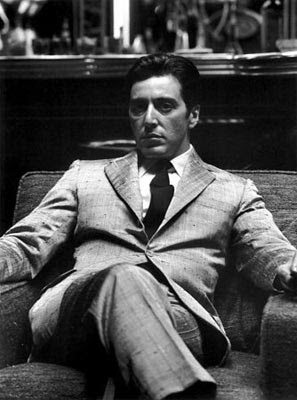
The opening scene of the movie The Godfather is an exquisite portrayal of reciprocity in action. It is the wedding day of the daughter of the Godfather, Don Corleone. The Italian immigrant Bonasera, an undertaker, has come to ask for a favor: He wants to avenge an assault upon the honor and body of his own daughter, who was beaten by her boyfriend and another young man. Bonasera describes the assault, the arrest, and the trial of the two boys. The judge gave them a suspended sentence and let them go free that very day. Bonasera is furious and feels humiliated; he has come to Don Corleone to ask that justice be done. Corleone asks what exactly he wants. Bonasera whispers something into his ear, which we can safely assume is "Kill them." Corleone refuses, and points out that Bonasera has not been much of a friend until now. Bonasera admits he was afraid of getting into "trouble." The dialogue continues:
CORLEONE: I understand. You found paradise in America, you had a good trade, made a good living. The police protected you and there were courts of law. And you didn't need a friend like me. But now you come to me and you say, "Don Corleone give me justice." But you don't ask with respect. You don't offer friendship. You don't even think to call me "Godfather." Instead, you come into my house on the day my daughter is to be married, and you ask me to do murder, for money.
BONASERA: I ask you for justice.
CORLEONE: That is not justice; your daughter is still alive.
BONASERA: Let them suffer then, as she suffers. [Pause]. How much shall I pay you?
CORLEONE: Bonasera…Bonasera…What have I ever done to make you treat me so disrespectfully? If you'd come to me in friendship, then this scum that ruined your daughter would be suffering this very day. And if by chance an honest man like yourself should make enemies, then they would become my enemies. And then they would fear you.
BONASERA: Be my friend—[He bows to Corleone]—Godfather? [He kisses Corleone's hand].
CORLEONE: Good. [Pause.] Some day, and that day may never come, I'll call upon you to do a service for me. But until that day—accept this justice as a gift on my daughter's wedding day.
The scene is extraordinary, a kind of overture that introduces the themes of violence, kinship, and morality that drive the rest of the movie. But just as extraordinary to me is how easy it is for us to understand this complex interaction in an alien subculture. We intuitively understand why Bonasera wants the boys killed, and why Corleone refuses to do it. We wince at Bonasera’s clumsy attempt to offer money when what is lacking is the right relationship, and we understand why Bonasera had been wary, before, of cultivating the right relationship. We understand that in accepting a "gift" from a mafia don, a chain, not just a string, is attached. We understand all of this effortlessly because we see the world through the lens of reciprocity. Reciprocity is a deep instinct; it is the basic currency of social life. Bonasera uses it to buy revenge, which is itself a form of reciprocity. Corleone uses it to manipulate Bonasera into joining Corleone's extended family.

Safety help us solve a long-standing puzzle of fictional pleasure, one that was beautifully summarized by David Hume in 1757:
It seems an unaccountable pleasure which the spectators of a well-written tragedy receive from sorrow, terror, anxiety, and other passions that are in themselves disagreeable and uneasy. The more they are touched and affected, the more they are delighted with the spectacle. . . . They are pleased in proportion as they are afflicted, and never are so happy as when they employ tears, sobs, cries, to give vent to their sorrow, and relieve their heart, swollen with the tenderest sympathy and compassion.
Hume is marveling at the fact that viewers of a tragedy get pleasure from emotions that are normally not good ones to have, such as sorrow, terror, and anxiety—the more of these emotions they get, the happier they are.
Fictional narrative appeals to us because ultimately we are safe from the dangers that afflict the characters. But indeed it is pleasurable and exciting because though we are safe, we are not in total control of what we experience in the narrative. And the lack of control and suspense is exactly what makes it pleasurable.
However it is important that we do have control over the intensity of the pain. The lover of spicy foods needs to have power over what's going into her mouth; the horror-movie fan gets to choose the movie and is free to close his eyes or turn his head. And in sadomasochism (S/M) it's critical for the person experiencing the M to have some sort of signal that means Stop and for the person doing the S to immediately respond. The signal is sometimes called, appropriately enough, a "safe" word.
Thus masochism isn't really about pain and humiliation, it's about suspense and fantasy. Control is essential and this is what makes masochistic pleasure so different from ordinary pleasure. In a disturbing discussion, the writer Daniel Bergnci describes how a horse buyer named Elvis chose to be basted with honey and ginger, tied to a metal pole, and roasted on a spit for three and a half hours. This is a lot of pain. My bet, though, that if Elvis woke up one morning, stepped out of bed, and badly stubbed his toe, he wouldn't enjoy it at all, because it is not what he signed up for.
The ultimate test case here is going to the dentist. One article on sadomasochism describes a woman with a high need for pain in S/M sessions with her boyfriend, but who hated going to the dentist. The boyfriend tried to get her to construe a dental exam as an erotic masochistic adventure, but failed. There was no getting around the fact that the dentist was necessary pain, in something she chose.
Finally, the technologies of the imagination provide stimulation of a sort that is impossible to get in the real world. A novel can span birth to death and can show you how the person behaves in situations that you could never otherwise observe. In reality you can never truly know what a person is thinking; in a story, the writer can tell you.
Such psychic intimacy isn't limited to the written word. There are conventions in other artistic mediums that have been created for the same purpose. A character in a play might turn to the audience and begin a dramatic monologue that expresses what he or she is thinking. In a musical, the thoughts might be sung; on television and in the movies, a voice-over may be used. This is commonplace now, but it must have been a revelation when the technique was first invented, and I wonder what young children think when they come across this for the first time, when they hear someone else's thoughts expressed aloud. It must be thrilling.
As another case of intimacy, consider the close-up. Certainly voyeurism has long been a theme of movies, from Rear Window to Disturbia, but the technique of film itself offers a unique way to satisfy our curiosity about the minds of others. Where else can you look full into someone's face without having the person look back at you? "Some viewers thrill to the prospect of views into the bedroom and bathroom," the philosopher Cohn McGinn writes, "but the film viewer can get even closer to the private world of his subject (or victim) —to his soul."
So while reality has its special allure, the imaginative techniques of books, plays, movies, and television have their own power. The good thing is that we do not have to choose. We can get the best of both worlds, by taking an event that people know is real and using the techniques of the imagination to transform it into an experience that is more interesting and powerful than the normal perception of reality could ever be. The best example of this is an art form that has been invented in my lifetime, one that is addictively powerful, as shown by the success of shows such as The Real World, Survivor, The Amazing Race, and Fear Factor. What could be better than reality television?
Day after day we seek an answer to the ageless question Aristotle posed in Ethics: How should a human being lead his life? But the answer eludes us, hiding behind a blur of racing hours as we struggle to fit our means to our dreams, fuse idea with passion, turn desire into reality. We’re swept along on a risk-ridden shuttle through time. If we pull back to grasp pattern and meaning, life, like a Gestalt, does flips: first serious, then comic; static, frantic; meaningful, meaningless. Momentous world events are beyond our control while personal events, despite all effort to keep our hands on the wheel, more often than not control us. Traditionally humankind has sought the answer to Aristotle’s question from the four wisdoms—philosophy, science, religion, art—taking insight from each to bolt together a livable meaning.
But today who reads Hegel or Kant without an exam to pass? Science, once the great explicator, garbles life with complexity and perplexity. Who can listen without cynicism to economists, sociologists, politicians? Religion, for many, has become an empty ritual that masks hypocrisy. As our faith in traditional ideologies diminish we turn to the source we still believe in: the art of story.
The world now consumes films, novels, theatre, and television in such quantities and with such ravenous hunger that the story arts have become humanity’s prime source of inspiration, as it seeks to order chaos and gain insight into life. Our appetite for story is a reflection of the profound human need to grasp the patterns of living, not merely as an intellectual exercise, but within a very personal, emotional experience. In the words of playwright Jean Anouilh, “Fiction gives life its form.”
Some see this craving for story as simple entertainment, an escape from life rather than an exploration of it. But what, after all, is entertainment? To be entertained is to be immersed in the ceremony of story to an intellectually and emotionally satisfying end. To the film audience, entertainment is the ritual of sitting in the dark, concentrating on a screen in order to experience the story’s meaning and, with that insight, the arousal of strong, at times even painful emotions, and as the meaning deepens, to be carried to the ultimate satisfaction of those emotions.
Whether it’s the triumph of crazed entrepreneurs over Hittite demons in Ghostbusters or the complex resolution of inner demons in Shine; the integration of character in The Red Desert, or its disintegration in The Conversation, all fine films, novels, and plays, through all shades of the comic and tragic, entertain when they give the audience a fresh model of life empowered with an affective meaning. To retreat behind the notion that the audience simply wants to dump its troubles at the door and escape reality is a cowardly abandonment of the artist’s responsibility. Story isn’t a flight from reality but a vehicle that carries us on our search for reality, our best effort to make sense out of the anarchy of existence.

