Showing posts with label politics. Show all posts

Friday, October 29, 2010

high-end / low-end state-building

There are basically two ways to run a state, what we might call high-end and low strategies. The high end, as its name suggests, is expensive. It involves leaders who centralize power, hiring and firing underlings who serve them in return for salaries in a bureaucracy or army. Paying salaries requires a big income, but the bureaucrats’ main job is to generate that income through taxes, and the army’s job is to enforce its collection. The goal is a balance: a lot of revenue goes out but even more incomes in, and the rulers and their employees live off the difference.

The low-end model is cheap. Leaders do not need huge tax revenues because they do not spend much. They get other people to do the work. Instead of paying an army, rulers rely on local elites—who may well be their kinsmen—to raise troops from their own estates. The rulers reward these lords by sharing plunder with them. Rulers who keep winning wars establish a low-end balance: not much revenue comes in but even less goes out, and the leaders and their kin live off the difference.

- Ian Morris


Saturday, October 16, 2010

communism is fascism


A revolution that expects you to sacrifice yourself for it is one of daddy's revolutions.

Personal politics should inform societal politics.


Friday, October 15, 2010

the origin of the nation-state

The nation-state is more of an "imagined community"--an artificial construct largely created by political and economic elites to foster more expansive national trading markets and to secure overseas colonies.

The difficult challenge for the budding nation-state was how to eliminate all the internal pockets of resistance to free trade in a national market while at the same time enlisting the emotional support of its subjects--subjects its citizens the collective tasks of society, including the collection of taxes and the conscription of armies to protect its national interests. This was no easy matter since, in many ways, the Enlightenment idea of the detached, self-interested, autonomous agent only with his own material self in mind and determined to optimize his own property holdings strangely at odds with an effort to forge a collective sense of common purpose and identity. How does the nation-state convince millions of newly emancipated individuals to give up some of their autonomy and freedom to the state?

The answer was to create a compelling story about a common past, one appealing enough to capture the imagination of the people and convince them of their shared identity and common destiny. The architects of the modern nation-State understood the magnitude of the task ahead of them. After Italian state unification in 1861, Massimo D’Zeglio, the former prime minister of Piedmont, was said to have remarked, “We have made Italy, now we have to make Italians.”
Every nation in the modern era has created a myth of origins complete with its own heroes and heroines and past moments of trials and tribulations, often memorialized in elaborate rituals. In an increasingly disenchanted secular world, the nation had to establish a powerful new image of a people who shared a noble past and were destined for future greatness. At the same time, the nation had to create a convincing enough utopian vision of what lay ahead to win over the loyalty of its subjects and, later, citizens. If the road to immortality no longer lay with accepting Christ as savior, then at least it could be found in the relentless pursuit of unlimited material wealth in the form of the accumulation and exchange of property. In return for giving one’s allegiance to the state—the litmus test being whether the citizen would be willing to give his or her life for their country—the state would uphold its side of the covenant by protecting each person’s right to own and exchange private property in a free marketplace.
Creating a shared identity was also essential to making viable an unobstructed national market. Before there was an
England, France, Germany, and Italy, what existed was a thousand different stories and traditions being lived out in little hamlets, nestled in valleys and on mountainsides across the continent. Each story was passed on in a separate language or at least in a distinct dialect.
A myriad of local languages, customs, and regulations for conducting commerce kept the transaction costs high for producing and trading goods and services over a wide geographic terrain. Suppressing or even eliminating pockets of cultural diversity was an essential step in creating an efficient and seamless national market. Creating a single homogenized national myth required the often ruthless destruction or subordination of all the local stories and traditions that existed for centuries of European history.
The success of the nation-state model owes much to the adoption of rational processes for marshaling far activities. To begin with, it was necessary to establish a single dominant language in each country so that people could communicate with one another and understand shared meanings. It’s often thought that sharing a common language was indispensable to bringing people together under the aegis of the nation. However, that’s not generally the case. Take France, for example. In 1789, on the eve of the French Revolution, less than 50 percent of the people spoke French, and only 12 to 13 percent spoke it correctly. In northern and southern France, it would have been virtually impossible to find anyone who spoke French. At the time Italy was unified in 1861, only 2.5 percent of the population used the Italian language for everyday communication. In eighteenth-century Germany, fewer than 500,000 people read and spoke in the vernacular that later came to be the official German language, and many of them were actors who performed new works onstage or scholars writing for a small intellectual elite.
Much of the impetus for creating national languages had less to do with nation formation and more to do with the demographics facing the early print industry. Printers in the fifteenth and sixteenth centuries were anxious to expand the markets for the mass production of hooks. The problem was that while Latin was the official language of the Church and was used among European scholars and government officials in the palace courts, it represented too small a reading market for the new communications revolution. On the other hand, there were so many languages and dialects spoken across Europe that each one by itself would be too small a market to be commercially viable. The answer, in most countries, was to choose a single vernacular language, usually the most dominant in a region, and establish it as the language for reproduction in bibles and later for works of literature and science.
Even here, the languages that eventually became standard French, German, Spanish, Italian, and English were, in part, invented. They were usually the result of combining elements of all the various idioms spoken in a region and then standardizing the grammar. However, once a common language became accepted, it created its own mystique of permanence. People came to think of it as their ancestral tongue and the cultural tie that bound them together.

Tuesday, September 7, 2010

the yin and yang of everything

All things come into being by conflict of opposites.

- Heraclitus, 500 BC


Without Contraries is no progression. Attraction and Repulsion, Reason and Energy, Love and Hate, are necessary to Human existence.

- William Blake, 1790 AD


The ancient Chinese symbol of yin and yang represents the value of the eternally shifting balance between seemingly opposed principles. As the epigrams above from Heraclitus and Blake show this is not just an Eastern idea; it is Great Idea, a timeless insight that in a way summarizes the rest of this book. Religion and science, for example, are often thought to be opponents, but the insights of ancient religions and of modern science are both needed to reach a full understanding of human nature and the conditions of human satisfaction. The ancients may have known little about biology, chemistry, and physics, but many were good psychologists. Psychology and religion can benefit by taking each other seriously, or at least by agreeing to learn from each other while overlooking the areas of irreconcilable difference.

The Eastern and Western approaches to life are also said to be opposed: The East stresses acceptance and collectivism; the West encourages striving and individualism. But as we've seen, both perspectives are valuable. Happiness requires changing yourself and changing your world. It requires pursuing your own goals and fitting in with others. Different people at different times in their lives will benefit from drawing more heavily on one approach or the other.

And, finally, liberals and conservatives are opponents in the most literal sense, each using the myth of pure evil to demonize the other side and unite their own. But the most important lesson I have learned in my twenty years of research on morality is that nearly all people are morally motivated. Selfishness is a powerful force, particularly in the decisions of individuals, but whenever groups of people come together to make a sustained effort to change the world, you can bet that they are pursuing a vision of virtue, justice, or sacredness. Material self-interest does little to explain the passions of partisans on issues such as abortion, the environment, or the role of religion in public life.

An important dictum of cultural psychology is that each culture develops expertise in some aspects of human existence, but no culture can be expert in all aspects. The same goes for the two ends of the political spectrum. My research' confirms the common perception that liberals are experts in thinking about issues of victimization, equality, autonomy, and the rights of individuals, particularly those of minorities and nonconformists. Conservatives, on the other hand, are experts in thinking about loyalty to the group, respect for authority and tradition, and sacredness. When one side overwhelms the other, the results are likely to be ugly. A society without liberals would be harsh and oppressive to many individuals. A society without conservatives would lose many of the social structures and constraints that are so valuable. Anomie would increase along with freedom. A good place to look for wisdom, therefore, is where you least expect to find it: in the minds of your opponents. You already know the ideas common on your own side. If you can take off the blinders of the myth of pure evil, you might see some good ideas for the first time.

By drawing on wisdom that is balanced—ancient and new, Eastern and Western, even liberal and conservative—we can choose directions in life that will lead to satisfaction, happiness, and a sense of meaning. We can't simply select a destination and then walk there directly—the rider does not have that much authority. But by drawing on humanity's greatest ideas and best science, we can train the elephant, know our possibilities as well as our limits, and live wisely.

- Johnathan Haidt


yin and yang of politics

In psychological terms it is this same perennial fault line which helps explain that fundamental opposition in politics between 'right' and 'left'. The right wing view rests chiefly on the masculine values, centred on the exercise of power and the maintenance of order; what may be called the values of 'Father': This is innately conservative because it believes in upholding the established structures and institutions of society. It supports those values which it sees as holding society together: the symbols of the nation state, tradition, patriotism, conventional morality, the family, discipline, the need for strength to defend the existing order against its external and internal enemies. The left wing rests essentially on the feminine values of feeling and understanding, what may be called the values of 'Mother', in which it perceives the ruling order and the right-wing view in general to be so heartlessly deficient. It talks about liberty, compassion and equality. It protests against oppression and the injustices of the system. It proclaims the need to raise up all those whom society places 'below the line', the workers, anyone who can be seen as exploited or as underdogs. It does not wish to preserve a hierarchical order which it sees as corrupt and unjust. It believes in change and the vision of a future society which is fairer and more caring; in which everyone can have an equal chance; which is not bound by narrow exclusive nationalism but sees all humanity as one.

We see this same division between the values of 'Father' and 'Mother' in the way people's political views tend to change over the years: that general human tendency to follow the pattern summed up in the maxim of Huey Long, the one-time governor of Louisiana, that 'every man's political career reads like a book, from left to right'. 'When people are young, unsettled, just starting on the ladder of life, they are more inclined to take a 'feminine', 'below the line' view; to be idealistic, to feel deeply the injustices of the world, to rebel against what they see as the constraints of discipline, established convention and the stern values of 'Father': When, as they grow older and more mature, they themselves become more established, with more experience of the world, they are inclined to take a more masculine, 'above the line' view. Idealism gives way, as they would see it, to realism. They come to appreciate the conservative values of discipline, tradition and order. They at last see the point of those values of 'Father'. It was this familiar shift taking place in people's psychic perspective which gave rise to Bernard Shaw's famous dictum that “anyone who is not a socialist at twenty has no heart, anyone who is not a conservative at forty has no head”.

What happens in the archetypal version is that it shows what is necessary for the two sides to become in some way reconciled. The egocentricity and blindness of those exercising power above the line is redeemed by their recognition of the selfless values represented by those below the line. The whole community can thus be brought together in unity. This may, according to the archetypal pattern, be what ought to happen. What in the real world is more likely to happen is that the two sides remain locked in conflict.

- Christopher Booker


Friday, September 3, 2010

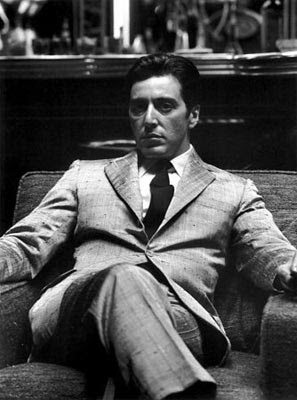
the godfather = reciprocity


Zigong asked: "Is there any single word that could guide one's entire life?" The master said: "Should it not be reciprocity? What you do not wish for yourself, do not do to others."

- Confucius


When the sages pick a single word or principle to elevate above all others, the winner is almost always either "love" or "reciprocity”. Love and reciprocity, ultimately, are about the same thing: the bonds that tie us to one another.

The opening scene of the movie The Godfather is an exquisite portrayal of reciprocity in action. It is the wedding day of the daughter of the Godfather, Don Corleone. The Italian immigrant Bonasera, an undertaker, has come to ask for a favor: He wants to avenge an assault upon the honor and body of his own daughter, who was beaten by her boyfriend and another young man. Bonasera describes the assault, the arrest, and the trial of the two boys. The judge gave them a suspended sentence and let them go free that very day. Bonasera is furious and feels humiliated; he has come to Don Corleone to ask that justice be done. Corleone asks what exactly he wants. Bonasera whispers something into his ear, which we can safely assume is "Kill them." Corleone refuses, and points out that Bonasera has not been much of a friend until now. Bonasera admits he was afraid of getting into "trouble." The dialogue continues:

CORLEONE: I understand. You found paradise in America, you had a good trade, made a good living. The police protected you and there were courts of law. And you didn't need a friend like me. But now you come to me and you say, "Don Corleone give me justice." But you don't ask with respect. You don't offer friendship. You don't even think to call me "Godfather." Instead, you come into my house on the day my daughter is to be married, and you ask me to do murder, for money.

BONASERA: I ask you for justice.

CORLEONE: That is not justice; your daughter is still alive.

BONASERA: Let them suffer then, as she suffers. [Pause]. How much shall I pay you?

CORLEONE: Bonasera…Bonasera…What have I ever done to make you treat me so disrespectfully? If you'd come to me in friendship, then this scum that ruined your daughter would be suffering this very day. And if by chance an honest man like yourself should make enemies, then they would become my enemies. And then they would fear you.

BONASERA: Be my friend—[He bows to Corleone]—Godfather? [He kisses Corleone's hand].

CORLEONE: Good. [Pause.] Some day, and that day may never come, I'll call upon you to do a service for me. But until that day—accept this justice as a gift on my daughter's wedding day.

The scene is extraordinary, a kind of overture that introduces the themes of violence, kinship, and morality that drive the rest of the movie. But just as extraordinary to me is how easy it is for us to understand this complex interaction in an alien subculture. We intuitively understand why Bonasera wants the boys killed, and why Corleone refuses to do it. We wince at Bonasera’s clumsy attempt to offer money when what is lacking is the right relationship, and we understand why Bonasera had been wary, before, of cultivating the right relationship. We understand that in accepting a "gift" from a mafia don, a chain, not just a string, is attached. We understand all of this effortlessly because we see the world through the lens of reciprocity. Reciprocity is a deep instinct; it is the basic currency of social life. Bonasera uses it to buy revenge, which is itself a form of reciprocity. Corleone uses it to manipulate Bonasera into joining Corleone's extended family.

- Jonathan Haidt


Tuesday, August 17, 2010

only right right-wing economic argument

In America, we tax work, growth, investment, employment, savings, and productivity. We subsidize nonworking, consumption, welfare, and debt.


Tuesday, July 27, 2010

scumbag merchant --> esteemed capitalist

I love the point about how modern philosophers reversed the moral hierarchy regarding the trader, the businessman. 


In all the cultures of antiquity, Western as well as non-Western, the merchant and the trader were viewed as lowlife scum. The Greeks looked down on their merchants, and the Spartans tried to stamp out the profession altogether. "The gentleman understands what is noble," Confucius writes in his Analects. “The small man understands what is profitable.” In the Indian caste system the vaisya or trader occupies nearly the lowest rung of the ladder—one step up from the despised untouchable. The Muslim historian Ibn Khaldun suggests that even gain by conquest is preferable to gain by trade, because conquest embodies the virtues of courage and manliness. In these traditions, the honorable life is devoted to philosophy or the priesthood or military valor. "Making a living" was considered a necessary, but undignified, pursuit. As Ibn Khaldun would have it, far better to rout your adversary, kill the men, enslave the women and children, and make off with a bunch of loot than to improve your lot by buying and selling stuff.

Drawing on the inspiration of modern philosophers like Locke and Adam Smith, the American founders altered this moral hierarchy. They argued that trade based on consent and mutual gain was preferable to plunder. The founders established a regime in which the self-interest of entrepreneurs and workers would be directed toward serving the wants and needs of others. In this view, the ordinary life, devoted to production, serving the customer and supporting a family, is a noble and dignified endeavor. Hard work, once considered a curse, now becomes socially acceptable, even honorable. Commerce, formerly a degraded thing, now becomes a virtue.

Of course the founders recognized that both in the private and the public sphere, greedy and ambitious people might pose a danger to the well-being of others. Instead of trying to outlaw these passions, the founders attempted a different approach. As the fifty-first book of The Federalist puts it, "Ambition must be made to counteract ambition." The argument is that in a free society "the security for civil rights must be the same as that for religious rights. It consists in the one case in the multiplicity of interests, in the other in the multiplicity of sects." The framers of the Constitution reasoned that by setting interests against each other, by making them compete, no single one could become strong enough to imperil the welfare of the whole.

In the public sphere the founders took special care to devise a system that would prevent, or at least minimize, the abuse of power. To this end they established limited government, in order that the power of the state would remain confined. They divided authority between the national and state governments. Within the national framework, they provided for separation of powers, so that the legislature, executive, and judiciary would each have its own domain of power. They insisted upon checks and balances, to enhance accountability.

In general the founders adopted a "policy of supplying, by opposite and rival interests, the defect of better motives." This is not to say that the founders ignored the importance of virtue. But they knew that virtue is not always in abundant supply. The Greek philosophers held that virtue was the same thing as knowledge—that people do bad things because they are ignorant—but the American founders did not agree. Their view was closer to that of St. Paul: "The good that I would, I do not. The evil that I would not, that I do." According to Christianity, the problem of the bad person is that his will is corrupted, and this is a fault endemic to human nature. The American founders knew they could not transform human nature, so they devised a system that would thwart the schemes of the wicked and channel the energies of flawed persons toward the public good.

The experiment that the founders embarked upon two centuries ago has largely succeeded in achieving its goals. We see the evidence in New York, which presents an amazing sight to the world. Tribal and religious battles, such as we see in Lebanon, Mogadishu, Kashmir, and Belfast, don't happen here. In New York restaurants, white and African-American secretaries have lunch together. In Silicon Alley, Americans of Jewish and Palestinian descent collaborate on e-commerce solutions and play racquetball after work. Hindus and Muslims, Serbs and Croats, Turks and Armenians, Irish Catholics and British Protestants, all seem to have forgotten their ancestral differences and joined the vast and varied parade of New Yorkers. Everybody wants to "make it," to "get ahead," to "hit it big." And even as they compete, people recognize that somehow they are all in this together, in pursuit of some great, elusive American dream. In this respect New York is a resplendent symbol of America.

My conclusion is that the American founders solved two great problems—the problem of scarcity, and the problem of diversity—that were a source of perennial misery and conflict in ancient societies, and that remain unsolved in the regimes of contemporary Islam. The founders invented a new regime in which citizens would enjoy a wide berth of freedom—economic freedom, political freedom, and freedom of speech and religion—in order to shape their own lives and pursue happiness. By separating religion from government, and by directing the energies of the citizens toward trade and commerce, the American founders created a rich, dynamic, and tolerant society that is now the hope of countless immigrants and a magnet for the world.

separation of church and state

One reason that separation of religion and government worked in America is that from the beginning the United States was made up of numerous, mostly Protestant, sects. The Puritans dominated in Massachusetts, the Anglicans in Virginia, the Catholics were concentrated in Maryland, and so on. No group was strong enough to subdue all the others, and so it was in every group's interest to "live and let live." The ingenuity of the American solution is evident in Voltaire's remark that where there is one religion, you have tyranny; where there are two, you have religious war; but where there are many, you have freedom.

freedom displaces virtue

To extreme Islamic thinkers, selective modernization (western technology, eastern culture) is an illusion. In their view, modernity is Western, and they regard as naive the notion that one can import what one likes from America while keeping out what one dislikes. The Islamic argument is that the West is based on principles that are radically different from those of traditional societies. In this view, America is a subversive idea that, if admitted into a society, will produce tremendous and uncontrollable social upheaval. It will eliminate the religious basis for society, it will undermine traditional hierarchies, it will displace cherished values, and it will produce a society unrecognizable from the one it destroyed. 


"Americans have two things on their mind: money and sex."


"Your women are whores."


"In our culture, the parents take care of the children, and later the children take care of their parents. In America, the children abandon their parents."


"Your TV shows are disgusting. You are corrupting the morals of young people."


"We don't object to how you Americans live, but now you are spreading your way of life through the whole planet."


Islam provides the whole framework for Muslim life, and in this sense it is impossible to "practice" Islam within a secular framework. Western institutions are fundamentally atheistic: they are based on a clear rejection of divine authority. When democrats say that sovereignty and political authority are ultimately derived from the people, this means that the people—not God—are the rulers. So democracy is a form of idol worship. Similarly capitalism is based on the premise that the market, not God, makes final decisions of worth. Capitalism, too, is a form of idolatry or market worship.

Rise of the West

1. Geography theory critique - If Europe enjoyed a natural geographic advantage from ancient times, then why during the thousand years between 500 A.D. and 1500 A.D., the West was a civilizational laggard and showed no signs of becoming the world's dominant civilization?

2. Oppression theory - Using war, imperialism, and slavery, the West colonized the rest of the world and got rich in the process; nothing innately superior of Western culture or civilization that enabled it to dominate the world. Critique - ethnocentrism, war, imperialism, and slavery are not unique to the West 

Resolution - the West became rich because it invented three institutions: science, democracy, and capitalism. These did not exist anywhere else in the world, nor did they exist in the West until the modern era. All three institutions are based on human impulses and aspirations that are universal, but these aspirations were given a unique expression in Western civilization.

Capitalism is based on a universal human impulse—the impulse to barter and trade. All societies have engaged in some form of exchange. Even the use of money is not Western in origin. But capitalism—by which I mean property rights, and contracts, and courts to enforce them, and free trade; in short, the whole ensemble of arrangements that Adam Smith described in The Wealth of Nations—is a Western institution.

Moreover, there is the psychology that is critical to capitalist success. Capitalism is based on the belief that the calling of the merchant or entrepreneur is a worthwhile one. In most societies merchants and entrepreneurs were regarded as lowlife scum and only in the West did their status improve.

Technology then arose out of the marriage between science and capitalism. Science provides the knowledge that leads to invention, and capitalism supplies the mechanism by which the invention is transmitted to the larger society, as well as the economic incentive for inventors to continue to make new things.

Colonialism and imperialism are not the cause of the West's success; they are the result of that success. The wealth and military power of the European powers made them arrogant and stimulated their appetite for global conquest: thus the British, the Dutch, and the French went abroad in search of countries to subdue and rule. These colonial possessions added to the prestige, and to a lesser degree to the wealth, of Europe. But the primary cause of Western affluence and power is internal—the institutions of science, democracy, and capitalism acting in concert. Consequently it is simply wrong to maintain that the rest of the world is poor because the West is rich, or that the West grew rich off "stolen goods" from Asia, Africa, and Latin America, because the West created its own wealth, and still does. The doctrine of oppression ignores this fact, and continues to fuel anti-Western resentment around the world and within the nations of the West.

Machiavelli

With Machiavelli we are thrust into modernity and the modern man. The state, in Machiavelli, is something man creates with his will and not with God's will.


There is no other way of guarding one's self against flattery than by letting men understand that they will not offend you by speaking the truth; but when everyone can tell you the truth, you lose their respect.


Machiavelli not only avoided talk of natural law or the ideal ends of life, he offered little evidence of what has come to be known as "essentialism"—any kind of a priori notion of an inherent quality in men or states or goals implanted by God. Men, being alone on this earth, could do—would do—what they willed. That is what most modern people, religious or not, actually believe, yet it was certainly new in the early sixteenth century. This brazen, unillusioned embrace of things as they are was both immensely exciting and, in its insistence on actuality, almost moral; it was irresponsible, Machiavelli was saying, to deny that life was like this, irresponsible to act as if men were good in the Christian sense—kind, loving, merciful, unselfish, forgiving. 

For it must be noted, that men must either be caressed or else annihilated; they will revenge themselves for small injuries, but cannot do so for great ones; the injury therefore that we do to a man must be such that we need not fear his vengeance.

Now that isn't simply cynical. More than anything, it's funny. And daring. Men cannot "revenge themselves" for great injuries because, as the beginning of the sentence suggests, and the last confirms, they will be dead. The humor of it was derived as much from the balanced economy of the clauses as from the idea itself; the syntax has the finality of murder.

…one ought to be both feared and loved, but as it is difficult for the two to go together, it is much safer to be feared than loved, if one of the two has to be wanting. For it may be said of men in general that they are ungrateful, voluble, dissemblers, anxious to avoid danger, and covetous of gain; as long as you benefit them, they are entirely yours; they offer you their blood, their goods, their life, and their children, as I have before said, when the necessity is remote; but when it approaches, they revolt. And the prince who has relied solely on their words, without making other preparations, is ruined; for the friendship which is gained by purchase and not through grandeur and nobility of spirit is bought but not secured, and at a pinch is not to be expended in your service. And men have less scruple in offending one who makes himself loved than one who makes himself feared; for love is held by a chain of obligation which, men being selfish, is broken whenever it serves their purpose; but fear is maintained by a dread of punishment which never fails.

Which is a stunning application of reason to nasty thoughts. God, what a mind! Unillusioned, he had attained a false reputation for callous amorality. He outraged the dull, who thought his work a mere handbook for dictators. But in his immense meditation on Roman history, The Discourses, parts of which we also read, Machiavelli spoke of republicanism and even of separate powers—people, rulers, senate—holding one another in check. And it became clear that Machiavelli, as Isaiah Berlin has pointed out, was no amoralist at all but a man who believed in an earlier, pagan sense of morality, the qualities of boldness, courage, dutifulness, stoicism, and so on, shared by Pericles and the leaders of the Roman Republic." These qualities would lead a state to glory. Christian morality was not wrong but generally useless in a leader and might even lead to greater disaster—in the sense of anarchy or chaos—than outright ruthlessness. What was paramount in the private realm might be hapless, even destructive, in the public realm. "We tend to reduce Machiavelli to a realist or power-mad tradition in which the end always justifies the means," said Stephanson. "But this is not true of Machiavelli. Sometimes it is justified to be ruthless, sometimes to be good. It's a pragmatic view, the opposite of a morality in which certain things are universal—such as that killing is always bad. But Machiavelli never says that the end justifies the means."

Saturday, July 24, 2010

social decorum

That one should follow the rules presupposes that the rules are legitimate. 

The groups that benefit from the status quo will of course follow the rules.

Those groups that are exploited by the system are the ones who benefit from breaking the rules.

If one believes that the rules are illegitimate, one finds no moral culpability in breaking them --> Robin Hood

Break the hierarchy of value, create a new one.


Wednesday, July 21, 2010

separation of church and state

The lesson that the West learned is that when the institutions of religion and government are one, and the secular authority is given the power to be the interpreter and enforcer of God's law, then horrible abuses of power are perpetrated in God's name. The West, as a consequence of its experience, learned to disentangle the institutions of religion and government--a separation that was most completely achieved in the United States.


Monday, July 19, 2010

John Rawls: The fact of pluralism

We must recognize that modern societies have become so large, populous and complex that we can no longer expect everyone to rally around some single set of shared values. Our society is one that favors lifestyle experimentation. Individuals are encouraged to find their own way, to discover their own sources of fulfillment. But this has important consequences. When it comes to answering the big "meaning of life"–type questions, this system of individual liberty generates more, not less, disagreement.

Generally speaking, this is a good thing. Not many of us would want to live in a society in which we are simply told what to think, whom to marry, what career to pursue or what to do with our free time. Yet our freedom to make these choices for ourselves means that often we must agree to disagree with one another about some of the major questions of life—the value of family, the existence of God, the sources of morality. We need to learn to live with disagreement—not just superficial disagreement, but deep disagreement, about the things that matter most to us. Furthermore, we cannot organize our social institutions around the assumption that some consensus is obtainable. The state, in particular, must treat all citizens equally, and this will mean, for the most part, remaining neutral with respect to all of these controversial questions of value.

- Andrew Potter


Wednesday, June 30, 2010

USA


For some reason when I look at this map, I don't get the sense that the United States of America is the most powerful, richest, badass country this world has ever seen, especially when I'm looking at Kentucky. In fact, this map reminds me of fifth-grade.

I'm sure some Muslim person in Afghanistan probably thinks differently.


.

they don't see this


they see this


Wednesday, June 16, 2010

Power


The accumulation of power does not provide security. Instead it feeds anxieties--the wealthy have few friends and thus inflames the desire to accumulate more power, to exercise ever greater control over other individuals and events. As Reinhold Niebuhr wrote: “The will-to-power is thus an expression of insecurity even when it has achieved ends which, from the perspective of an ordinary mortal, would seem to guarantee complete security.”

I find this quality of human nature ironic; the more powerful you become, the more insecure you become. It's a vicious cycle: insecurity-->drive to obtain power-->fear of losing one's power/position-->more insecurity

Tuesday, May 18, 2010

Political Brands

Brands serve a useful purpose. You know what you're getting if you buy a Big Mac, an iPod, or a copy of Microsoft Windows. Same goes for political brands: Democrat or Republican? John McCain or Barack Obama? Pepsi or Coke?

Consider how brands work. The central question that every consumer faces is, “How do I know I’m not getting ripped off?” How do you know that this bag of flour isn’t adulterated or that these new shoes won’t fall apart the minute you get home? Unless you’ve managed to follow the entire production process from start to finish, you don’t. You trust the flour isn’t full of sawdust because Robin Hood says so. You have faith the sneakers will withstand a running season or two because Nike has put its swoosh on them. Brands are one of the earliest and most effective forms of consumer protection, where trust in the brand (and the company behind it) substitutes for first-hand knowledge or expertise.

Political brands work the same way. In an election, the question every voter needs an answer to is, “How do I know what I’m buying into with my vote? How do I know I’m not getting snookered?” This is where political brands, better known as parties, come in. The role of the party is more or less to take the dense convolutions of modern governance and reduce them to a relatively simple brand proposition. Are you generally in favor of a strong central government that will build national social programs? Then vote Democrat (or, in Canada, Liberal). Would you prefer a more decentralized federation and limited state interference in your life and in the economy? Then the Republicans or Conservatives are the party for you.

The paradox of all branding is that the more complicated things get, the simpler the messaging has to be, which is why politics has become so intensely focused on the party leader’s character and image. It’s pretty remarkable that in an election in which American voters were being asked to decide who would control a budget of somewhere north of $3 trillion, they were essentially offered a choice between two brands: Barack Obama’s “Change” and John McCain’s “Honor.” But what is more surprising still is how well the system actually works. Most people don’t have the time or, frankly, the ability to properly digest budgets, policy documents, or drafts of new bills, and the distillation of the stupendous complexities of the modern state to a handful of simple but distinct brands is not just useful, but necessary. As in the consumer economy so in modern politics — both would grind to a halt without brands as a lubricant.


What of the worry that politics ends up being marketed like Big Macs, pitched to the lowest common denominator? The proper reply is to this is, So what? People always put the emphasis in that phrase on the word lowest, when it should be placed on the word common. The government wields a monopoly over the use of violence, among other things, and any party that wants to claim the right to use violence had darn well better make sure it has the lowest common denominator on its side or it is in big trouble. To adapt a line from the genius of twentieth-century advertising, David Ogilvy: the lowest common denominator is not a fool, she is your neighbor. In a democracy, every politician is in the business of selling electoral Big Macs, and anyone who thinks that’s not his job is either a born loser or a tyrant manqué.


We need to give voters a little more credit. People are no more bamboozled by a John McCain action figure into voting for John McCain than they are tricked into buying a PC because Jerry Seinfeld is in the ad. That just isn’t the way branding or human behavior works. Indeed, whether it’s Nike’s swoosh, or the ubiquitous Hope poster of Obama designed by Shep Fairey, or Stephen Harper’s blue sweater vest, no one ever admits to being a dupe of the marketing. The worry is always that other people — in particular, the people who support the other side — are being manipulated. And so throughout the Bush years, the left in America complained about the way Karl Rove and Dick Cheney were sowing fear and panic over terrorism and keeping the religious right all a-boil over fears about abortion and Mexican immigrants. Once Obama became president and the Democrats took control of both houses of Congress, the right immediately started complaining that the electorate had been duped by his pretty speechifying and his wispy promises about Hope and Change.

This is a slippery slope, and it is dangerous for anyone, no matter what their partisan allegiances, to have so much contempt for voters. Democracy is based on the premise that reasonable people can disagree over issues of fundamental importance from abortion and gay rights to the proper balance between freedom and security. When the mere fact that someone supports the other side becomes evidence that they have been brainwashed, then the truth is you no longer believe in democracy.